


Interview by Eva Coutts
Hannah Quigley has been finding out how taking part in sign language choirs can benefit the participants.
What is your graduation project about?
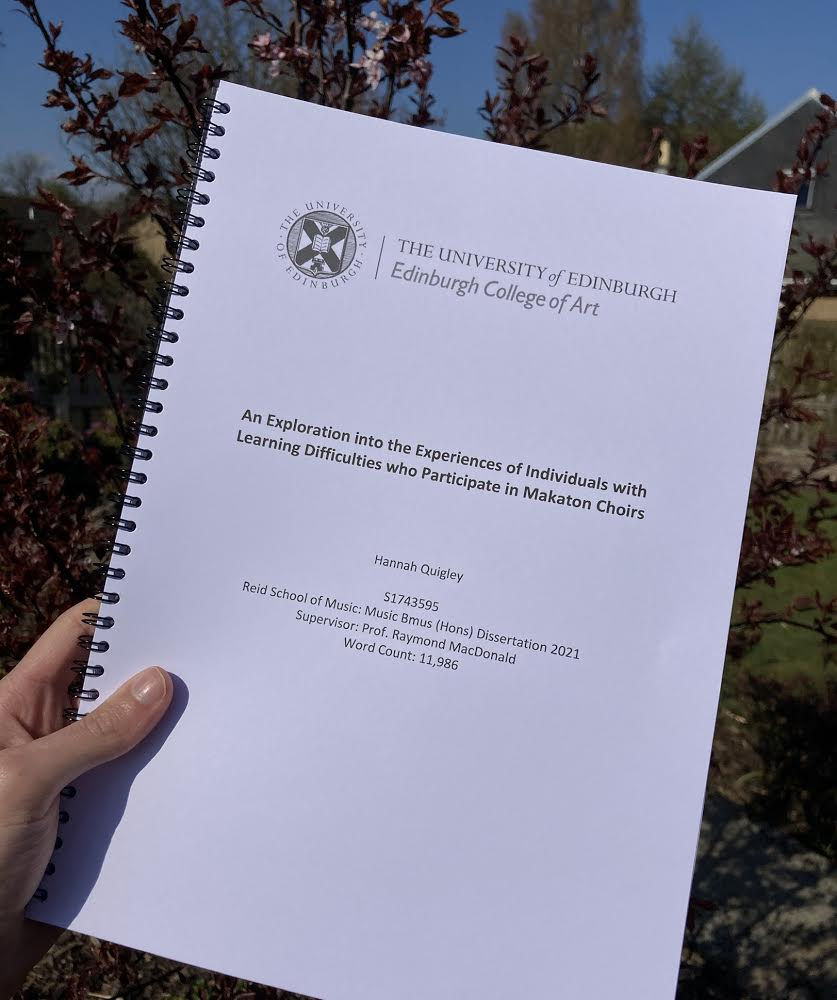
My graduation project is a study investigating the experiences of individuals with learning difficulties who participate in Makaton choirs. Makaton is a form of sign language.
The last ten years has witnessed a significant growth in a range of community singing groups, including the phenomenon of Makaton choirs which use Makaton as their main mode of musical performance.
The primary method of research was through interviews conducted with five choir members and the leader. These interviews concluded that participants reported increased opportunities for social connection with others. Participants also reported that performing sign language to song supported the acquisition of Makaton, leading to improvements in communication. The study also found that an improved ability to use and understand Makaton sign language allows participants to access the lyrical content of songs, leading to an enhanced understanding of the experience of emotion through music.
How do you best like to work?
My working style and methods are generally very structured. I try to treat university study like a 9-5 job as much as possible, often with the addition of weekend work. In this way, I aimed to sustain a sense of normality despite the new challenges associated with working from home due to COVID-19.
Can you tell us about some of the things which inspire you and your work?
The motivation to explore the topic for my final year project was sparked by my personal involvement delivering community music workshops at schools for primary age learners with complex, long term and additional support needs, where Makaton Sign Language was regularly used by both teachers and pupils.
Throughout my time at ECA, I also developed a big interest in the area of music, health and wellbeing, specifically in relation to music psychology, community music and music therapy. I have been inspired by the work of others working within these related areas, including two of my lecturers based at the Reid School of Music, Dee Isaacs and Raymond MacDonald.
What have been the highlights of your time at ECA and in Edinburgh?
My involvement in the Music in the Community course based at the Reid School of Music has been a definite highlight of my time at ECA.
During my two years on this course, I have been lucky to have had the opportunity to be involved in two six-month-long placements at schools for children with additional, complex needs and more severe learning difficulties where I was involved in creating accessible community music workshops for these children.
These placements provided me with extremely valuable experience and skills for the future and reaffirmed my decision to apply for a MSc in music therapy at the end of last year.
Have you got plans for after graduating?
I am due to begin a MSc in music therapy at Queen Margaret University in September. In terms of my more immediate plans, I am currently in contact with a nurse based at the Royal Infirmary in Edinburgh about the possibility of setting up online singing for breathing/lung health sessions for their respiratory ward as well as for patients suffering the long-term effects of COVID-19.